


Como cliente Amazon Prime obtén 3 meses de Audible gratis
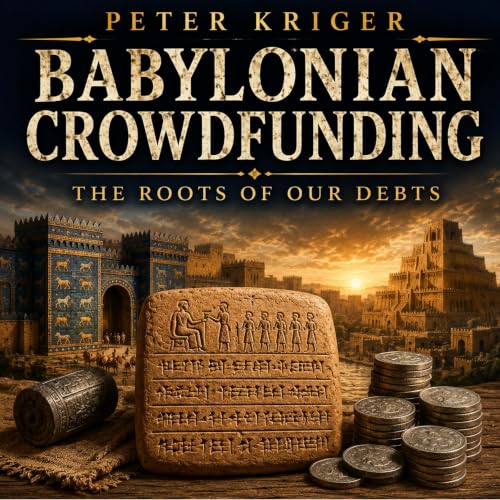
Babylonian Crowdfunding
The Roots of Our Debts
No se ha podido añadir a la cesta
Error al eliminar la lista de deseos.
Se ha producido un error al añadirlo a la biblioteca
Se ha producido un error al seguir el podcast
Error al dejar de seguir el podcast
Escúchalo ahora gratis con tu suscripción a Audible

Babylonian Crowdfunding
Compra ahora por 14,99 €
-
Narrado por:
-
Emma Maxey
-
De:
-
Peter Kriger
Five thousand years ago, somebody poured a season's worth of grain into a shared building and immediately ran into a problem that has never once gone away: who gave what, and who gets it back? The answer was to write it down. That small, unheroic act—the receipt—set loose nearly everything we now call civilization. To keep the receipts, people invented writing. To carve up the fields that fed the shared pile, they invented working numbers. And to move wealth across time, from a fat year into a lean one, they invented the loan, with its patient, compounding appetite.
Babylonian Crowdfunding follows a single machine—the debt that can be counted, sold, and enforced—from a lump of clay in a temple storeroom to the mortgage statement sitting in your inbox right now. Without a single equation, it explains why interest grows the way a herd grows, why one family's ruin can travel through a whole town of lenders like weather, and why the people who first built this machine were, in one specific respect, more frightened of it than we are. They kept an emergency brake—a periodic wiping-clean of debts—and they pulled it, on purpose, for centuries. We have quietly unscrewed that same brake and agreed to call its absence progress.
This is not a love song to debt, and it is not a curse laid across it. It is a field guide to the invisible contraption we all live inside—the one so old and so constant that, like water to a fish, we have stopped noticing it is there at all. The same brilliant trick that lets total strangers trust one another is the trick that, carried to its logical end, can pledge a living human being as collateral. That is not a flaw in the machine. That is the machine. Once you learn to see it, you will find it very hard to unsee—in a pawnshop window, in a national budget, in the fine print you have never read, and in the strange, ancient weight of the word owe.
©2026 Peter Kriger (P)2026 Peter Kriger


