


Como cliente Amazon Prime obtén 3 meses de Audible gratis
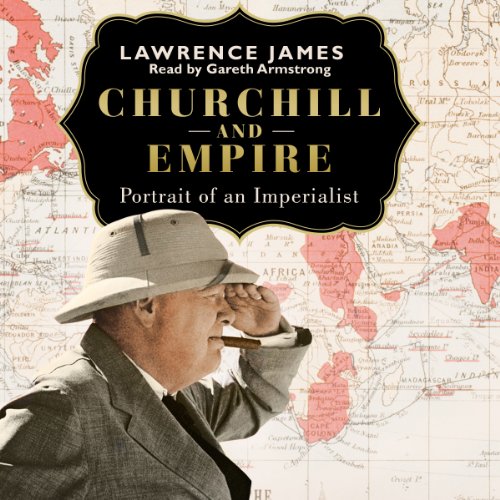
Churchill and Empire
No se ha podido añadir a la cesta
Error al eliminar la lista de deseos.
Se ha producido un error al añadirlo a la biblioteca
Se ha producido un error al seguir el podcast
Error al dejar de seguir el podcast
0,99 € al mes durante los primeros 3 meses

Churchill and Empire
Compra ahora por 18,91 €
-
Narrado por:
-
Gareth Armstrong
-
De:
-
Lawrence James
One of our finest narrative historians, and journalist for the Sunday Times and Literary Review, Lawrence James, has written a genuinely new biography of Winston Churchill, set within a fully detailed historical context, but solely focusing on his relationship with the British Empire.
As a young army officer in the late 19th century, Churchill's first experience of the Empire was serving in conflicts in India, South Africa and the Sudan. His attitude towards the Empire at the time was the stereotypical Victorian paternalistic approach - a combination of feeling responsible and feeling superior. Conscious even then of his political career ahead, Churchill's natural benevolence towards the Empire was occasionally overruled for political reasons, and he found himself reluctantly supporting - or at least not publicly condemning - British atrocities.
As a politician he consistently relied on the Empire for support during crises, but was angered by any demands for nationalisation. He held what many would regard today as racist views, in that he felt that some nationalities were superior to others, but he didn't regard those positions as fixed. His (some might say obsequious) relationship with America reflected that view. America was a former colony where the natives had become worthy to rule themselves, but - he felt - still had that tie to Britain. Thus he overlooked the frequently expressed American view that the Empire was a hangover from a bygone era of colonisation, and reflected poorly on Britain's ability to conduct herself as a political power in the current world order.
This outmoded attitude was one of the reasons the British voters rejected him after a Second World War, in which - it was universally felt - he had led the country brilliantly. His attitude remained Victorian in a world that was shaping up very differently. However, it would be a mistake to consider Churchill merely as an anachronistic soldier. He grasped the problems of the Cold War immediately, believing that immature nations prematurely given independence would be more likely to be sucked into the vortex of Communism. This view chimed with American foreign policy, and made the Americans rather more pragmatic about their demands for self-governance for Empire countries.
Lawrence James has written a fascinating portrait of an endlessly interesting statesman - and one that includes tantalising vignettes about his penchants for silk underwear and champagne.
©2013 Lawrence James (P)2014 Orion Publishing Group


