


Como cliente Amazon Prime obtén 3 meses de Audible gratis
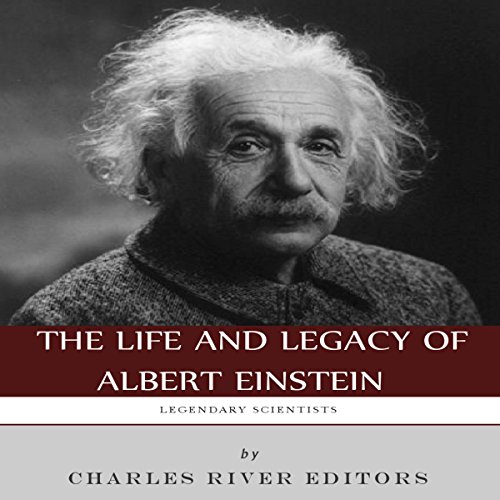
Legendary Scientists: The Life and Legacy of Albert Einstein
No se ha podido añadir a la cesta
Error al eliminar la lista de deseos.
Se ha producido un error al añadirlo a la biblioteca
Se ha producido un error al seguir el podcast
Error al dejar de seguir el podcast
Escúchalo ahora gratis con tu suscripción a Audible

Legendary Scientists: The Life and Legacy of Albert Einstein
Compra ahora por 5,45 €
-
Narrado por:
-
Edoardo Camponeschi
"Nature shows us only the tail of the lion. But there is no doubt in my mind that the lion belongs with it even if he cannot reveal himself to the eye all at once because of his huge dimension." - Albert Einstein
Albert Einstein (1879-1955) needs no formal introduction. He is remembered around the world as one of history's most brilliant geniuses, and one of its most influential scientists. Einstein is often regarded as the father of modern physics, and he received the 1921 Nobel Prize in Physics "for his services to theoretical physics, and especially for his discovery of the law of the photoelectric effect". And though he is best known for his contributions to science with over 300 scientific papers, the witty Einstein also wrote over 150 non-scientific works, many of them infused with his humor. The entire package of his life and career has ensured that people continue to describe intelligent people as "Einsteins".
Einstein's greatest and most famous theory is the theory of relativity, which fundamentally changed the understanding of physics and astronomy during the 20th century. When first published, relativity superseded a 200-year-old theory of mechanics put forth by Isaac Newton. The theory of relativity overturned the concept of motion from Newton's day, into all motion is relative. Time was no longer uniform and absolute. Therefore, physics is no longer understood as space by itself, and time by itself. Instead, an added dimension had to be taken into account in the form of curved spacetime. Time now depended on velocity, and contraction became a fundamental consequence at appropriate speeds.
©2012 Charles River Editors (P)2015 Charles River Editors


