


Como cliente Amazon Prime obtén 3 meses de Audible gratis
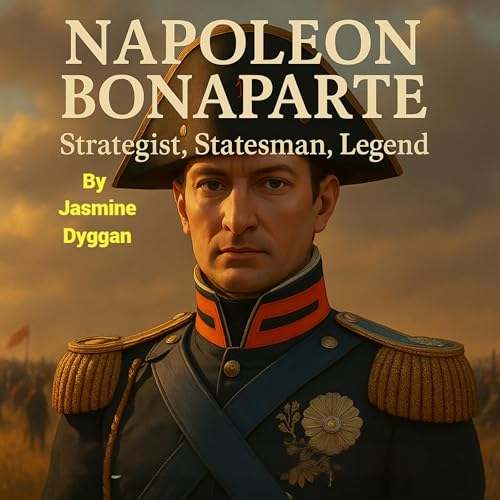
Napoleon Bonaparte
Strategist, Statesman, Legend
No se ha podido añadir a la cesta
Error al eliminar la lista de deseos.
Se ha producido un error al añadirlo a la biblioteca
Se ha producido un error al seguir el podcast
Error al dejar de seguir el podcast
0,99 € al mes durante los primeros 3 meses

Napoleon Bonaparte
Compra ahora por 7,03 €
-
Narrado por:
-
Sage Nuñez-String
-
De:
-
Jasmine Dyggan
Napoleon Bonaparte remains one of the most fascinating and controversial figures in world history. A man of immense genius and relentless ambition, he rose from obscure beginnings on the island of Corsica to become Emperor of the French, reshaping Europe in his image and leaving a legacy that still reverberates today. To some, he was a tyrant who plunged nations into endless war; to others, a visionary reformer who dragged Europe into modernity. His story is both an epic of triumph and tragedy and a timeless lesson on the power—and peril—of ambition.
Born in 1769 to a modest Corsican family, Napoleon’s early years gave little hint of the destiny that awaited him. He was ridiculed for his accent and origins, yet driven by discipline, intellect, and relentless determination, he excelled at France’s military academies. By his early twenties, the French Revolution had given him the chance to rise rapidly through the ranks. At Toulon, he demonstrated brilliance as an artillery commander; in Italy, he unleashed dazzling campaigns that astonished Europe. Soldiers adored him for his charisma and daring, and politicians soon learned to both admire and fear him.
But Napoleon was far more than a general. In 1799, through the coup of 18 Brumaire, he seized political power and made himself First Consul. Five years later, he crowned himself Emperor, shattering tradition and declaring that he owed his authority to no one but himself. His reign brought sweeping reforms: the Napoleonic Code, still a foundation of modern legal systems; a centralised administration; merit-based education; and the reorganisation of finance and taxation. Wherever his armies marched, they carried not only cannons but also ideas—principles of equality before the law, secular governance, and the dismantling of feudal privilege.
Yet Napoleon’s insatiable ambition drove him beyond reform at home. He sought to dominate the continent, building an empire that stretched from Spain to Poland. His military genius reached its height at Austerlitz, Jena, and Wagram, where his tactical brilliance crushed larger coalitions and redrew Europe’s map. He placed family members on thrones, spread his institutions across borders, and seemed, for a time, unstoppable. The golden eagle of France soared higher than ever before.
But every empire meets its limits. Britain’s naval supremacy defied him, Spain drained his armies with brutal guerrilla warfare, and in 1812 his ill-fated invasion of Russia shattered the Grande Armée, transforming triumph into catastrophe. By 1814, the Allied powers forced his abdication and exiled him to Elba. Remarkably, he escaped, returned for the dramatic Hundred Days, and rallied France once more—only to be decisively defeated at Waterloo in 1815. Captured and sent into permanent exile on the remote island of Saint Helena, Napoleon lived out his final years dictating memoirs, shaping his legend even in defeat. He died in 1821 at the age of 51, leaving behind both myth and controversy.
Napoleon’s legacy is a paradox. He caused untold suffering, yet spread modern reforms that outlived him. He crowned himself Emperor, yet championed meritocracy. He destroyed nations, yet built systems of law and governance still in use today. Two centuries later, he continues to inspire debate: Was he a hero or a tyrant, a liberator or an oppressor, a genius undone by pride or a visionary cut down by circumstance?
This book, Napoleon Bonaparte: Strategist, Statesman, Legend, explores ten essential chapters of his extraordinary life, from his Corsican roots to his rise as Europe’s most feared general, from the grandeur of his empire to the bitterness of his exile. It paints a vivid portrait of a man who changed history not only with the sword, but with the pen and the law.
©2025 Deep Vision Media t/a Zentara UK (P)2025 Deep Vision Media t/a Zentara UK


