Como cliente Amazon Prime obtén 3 meses de Audible gratis
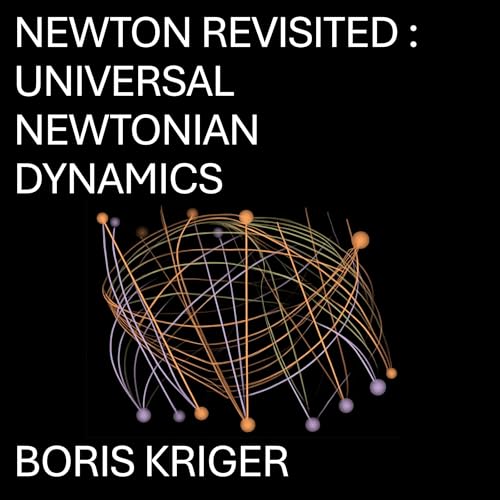
Newton Revisited
Universal Newtonian Dynamics (Science and Cosmos)
No se ha podido añadir a la cesta
Error al eliminar la lista de deseos.
Se ha producido un error al añadirlo a la biblioteca
Se ha producido un error al seguir el podcast
Error al dejar de seguir el podcast
0,99 € al mes durante los primeros 3 meses

Newton Revisited
Compra ahora por 9,82 €
-
Narrado por:
-
Floyd Dameron
-
De:
-
Boris Kriger
Why do economists, engineers, epidemiologists, and AI researchers all discover that they need to track momentum in their models? Why do first-order predictions consistently fail at turning points? Why does the same corrective technique keep being reinvented across unrelated fields?
The answer lies in a structural principle hidden in plain sight for three centuries. Newton's laws of motion are not merely descriptions of physical matter. They are the necessary mathematical form for any system where multiple influences combine and act on trends rather than levels directly.
In this work, Boris Kriger reveals Universal Newtonian Dynamics: a framework that transforms Newton's physics into a general modeling principle. Drawing on rigorous mathematical foundations, Kriger shows that markets, epidemics, learning systems, social movements, and organizations all satisfy the same structural axioms, and therefore all require the same second-order dynamical treatment.
This is not mere analogy. It is mathematical necessity.
Written in an accessible, conversational style, Newton Revisited takes listeners on a journey from the foundations of classical mechanics to the frontiers of interdisciplinary science. Along the way, Kriger provides practical diagnostic tools for evaluating models, explains why certain modeling failures are structural rather than incidental, and makes a compelling case for interdisciplinary thinking as the key to scientific progress.
©2026 Boris Kriger (P)2026 Boris KrigerContinuar la serie