


Como cliente Amazon Prime obtén 3 meses de Audible gratis
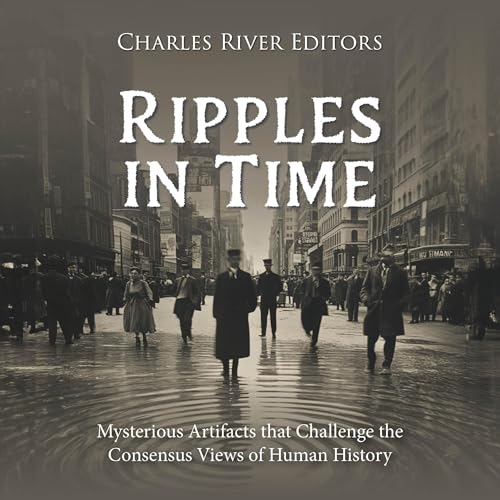
Ripples in Time
Mysterious Artifacts that Challenge the Consensus Views of Human History
No se ha podido añadir a la cesta
Error al eliminar la lista de deseos.
Se ha producido un error al añadirlo a la biblioteca
Se ha producido un error al seguir el podcast
Error al dejar de seguir el podcast
Suscríbete a la prueba gratuita para poder disfrutar de este libro a un precio exclusivo para suscriptores

Ripples in Time
Compra ahora por 5,96 €
-
Narrado por:
-
KC Wayman
We take time for granted as it passes during every moment of our existence. Other things may change, but time remains constant and predictable. The past, the present, and the future exist within a harmonious, reliable, and never-changing system. Or at least that’s how it seems…
It was Albert Einstein who, in 1905, first theorized that time might not be quite as straightforward as that. In one of the most influential papers on physics ever published, he proposed something called “time dilatation.” This suggested that time was neither fixed nor constant and that the passage of time was related to the relative speed of the observer. The closer an object approached the speed of light, the more notable this effect was. For example, if it were possible to build an interstellar craft capable of reaching speeds that approached the speed of light, the passengers on that ship might experience the passage of a single year during a voyage, but when they returned to Earth, they might find that dozens of years had passed on the planet.
That was a truly revolutionary idea back in 1905, and it wasn’t until the 1960s that technology had advanced to the point that it was possible to conduct experiments to check Einstein’s theory by measurement. Those experiments and subsequent tests proved that he was entirely correct. Even in 1908, new theories proposed that time was the fourth dimension of spacetime and that it wasn’t fixed at all but governed by the same laws of relativity that applied to other aspects of physics.
These were exciting developments, and current theories of physics have taken this idea even further, suggesting that both space and time are “emergent,” that is, directly (and perhaps variably) related to other elements of the natural world in ways we still don’t fully understand. In later years, Einstein himself would say in a letter to a friend, “The distinction between past, present, and future is only a stubbornly persistent illusion.”


