Prime Day

Como cliente Amazon Prime obtén 3 meses de Audible gratis
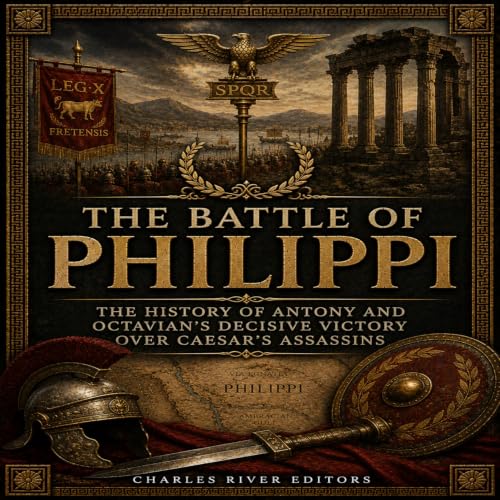
Diseño de la portada del título The Battle of Philippi: The History of Antony and Octavian’s Decisive Victory Over Caesar’s Assassins

The Battle of Philippi: The History of Antony and Octavian’s Decisive Victory Over Caesar’s Assassins

Muestra
Comenzar mi suscripción Prueba gratis durante 30 días
Oferta válida hasta el 28 de diciembre de 2026.
Después de los 30 días, 9,99 €/mes. Cancela tu siguiente plan mensual cuando quieras.
Ahorra más del 90% en tus primeros 3 meses.
Escucha todo lo que quieras de entre miles de audiolibros y Originals incluidos.
Descarga tu audiolibro y escucha offline, sin interrupciones
Se renueva automáticamente por 9,99 €/mes después de 3 meses. Cancela mensualmente. La oferta termina el 28 de diciembre de 2026.
Disfruta de forma ilimitada de este título y de una colección con 90.000 más.
Escucha cuando y donde quieras, incluso sin conexión.
Sin compromiso. Cancela tu siguiente plan mensual cuando quieras.

The Battle of Philippi: The History of Antony and Octavian’s Decisive Victory Over Caesar’s Assassins

De: Charles River Editors
Narrado por: Steve Knupp
Prueba gratis durante 30 días Prueba gratis durante 30 días

Después de los 30 días, 9,99 €/mes. Cancela cuando quieras.

Después de los 30 días, 9,99 €/mes. Cancela cuando quieras.

Compra ahora por 7,99 €

Compra ahora por 7,99 €

Ahorros de temporada | 0,99 € al mes durante los primeros 3 meses

9,99 €/mes después. Se aplican condiciones. Cancela mensualmente.
Julius Caesar was possibly the most important man of antiquity, if not all of history. Alexander Hamilton once remarked that “the greatest man who ever lived was Julius Caesar.” Such a tribute, coming from one of the Founding Fathers of the quintessential modern democracy in reference to a man who destroyed the Roman Republic, is testament to the enduring mark that Caesar left upon the world. The ultimate conqueror, statesman, dictator, visionary, and opportunist, during his time in power Caesar expanded the borders of Rome to almost twice their previous size, revolutionized the infrastructure of the Roman state, and finished the Roman Republic for good, leaving a line of emperors in its place. His legacy is so strong that his name has become, in many languages, synonymous with power: the emperors of Austria and Germany bore the title kaiser, and the tsars of Russia also owe the etymology of their title to Caesar. His name also crept further eastward out of Europe, even cropping up in Hindi and Urdu, where the term for “emperor” is kaisar.Even in his time, Caesar was in many ways larger than life, and because of his legacy as virtual founder of the Roman Empire, much of what was written about and by him during his life and immediately after his assassination was politically motivated. The fact that he was murdered on the Ides of March is universal knowledge, as is the name of his most famous assassin. Marcus Brutus has been history’s most notorious assassin since the Ides of March in 44 B.C., but aside from his conspiracy, the rest of his life is often overlooked, especially his role in the subsequent civil war. In fact, forces loyal to Brutus and the other main conspirator, Cassius, fought one of the biggest battles in Roman history against Octavian and Mark Antony at Philippi, and it was one that they very nearly won. However, by the end of the decisive battle, Brutus and Cassius had lost, and both had taken their own lives.©2026 Charles River Editors (P)2026 Charles River Editors Antigua Europa
adbl_web_anon_alc_button_suppression_t1
No hay reseñas aún