Como cliente Amazon Prime obtén 3 meses de Audible gratis
The Philosophy of Entropy
Order, Decay, and the Meaning of Equilibrium
No se ha podido añadir a la cesta
Error al eliminar la lista de deseos.
Se ha producido un error al añadirlo a la biblioteca
Se ha producido un error al seguir el podcast
Error al dejar de seguir el podcast
Escúchalo ahora gratis con tu suscripción a Audible

The Philosophy of Entropy
Compra ahora por 9,82 €
-
Narrado por:
-
Timothy Hagaman
-
De:
-
Boris Kriger
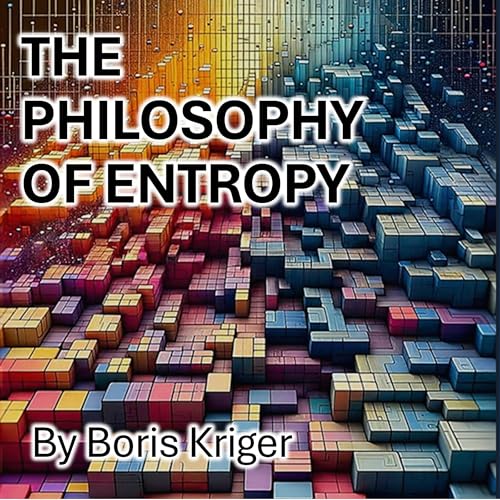
Entropy is one of the most profound and misunderstood concepts in modern science — at once a physical quantity, a measure of uncertainty, and a metaphor for the passage of time itself. Entropy: The Order of Disorder explores this concept in its full philosophical and scientific depth, tracing its evolution from the thermodynamics of Clausius and Boltzmann to the cosmology of the expanding universe, the information theory of Shannon, and the paradoxes of quantum mechanics.
At the heart of this study lies a critical insight: entropy in its ideal form can exist only in a perfectly closed and isolated system — a condition that is impossible to realize, even for the universe itself. From this impossibility arises the central tension of modern thought: the laws that describe equilibrium govern a world that never rests.
Bridging physics, philosophy, and cosmology, this book examines entropy as a universal principle of transformation rather than decay. It situates the second law of thermodynamics within a broader intellectual landscape, connecting it to the philosophies of Heraclitus, Kant, Hegel, and Whitehead, and to contemporary discussions of information, complexity, and emergence.
With both scientific rigor and literary clarity, Entropy: The Order of Disorder invites listeners to reconsider the nature of time, the limits of isolation, and the open, evolving character of reality itself. Entropy, it suggests, is not the death of order but its necessary condition — the measure of a universe that survives precisely because it can never be perfectly closed.
This work will appeal to physicists, philosophers, and listeners across the sciences and humanities who seek to understand how the most universal law of decay reveals the unending creativity of the cosmos.
Continuar la serie