


Como cliente Amazon Prime obtén 3 meses de Audible gratis
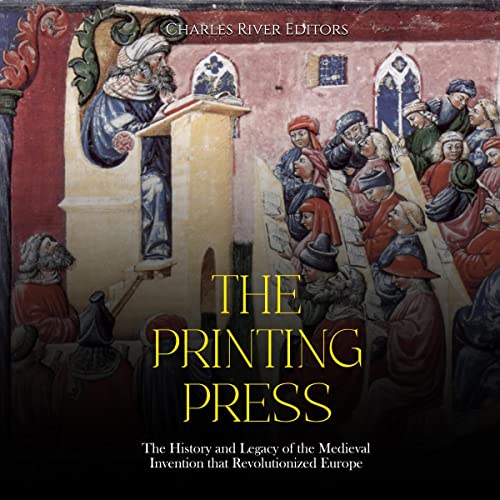
The Printing Press
The History and Legacy of the Medieval Invention that Revolutionized Europe
No se ha podido añadir a la cesta
Error al eliminar la lista de deseos.
Se ha producido un error al añadirlo a la biblioteca
Se ha producido un error al seguir el podcast
Error al dejar de seguir el podcast
0,99 € al mes durante los primeros 3 meses

The Printing Press
Compra ahora por 5,96 €
-
Narrado por:
-
KC Wayman
“What gunpowder did for war, the printing press has done for the mind.” (Wendell Phillips)
The crucial importance of education in China, a prized virtue instilled in the population among all classes by beloved teacher and philosopher Confucius in the 6th century BCE, generated an unprecedented and long-lived golden age of literature and art. It also gave rise to a cornucopia of transformative innovations and groundbreaking technology, particularly following the dawn of the Common Era.
In addition to the wheelbarrow, the seismograph, the waterwheel, deep drilling, suspension bridges, and ship rudders, among countless other life-changing contraptions, the Chinese developed what were later dubbed the “Four Great Inventions of China.” One of those was printing, which slowly spread through South Asia and the Middle East before making it to Europe.
The history of printing was for ancient Asia an advancement in culture and communication, but for Europe in the 15th century, it was much more, plunging the continent into a new paradigm and aligning it for the modern world. Its importance is often overlooked, but the timeliness of the printing machine was equivalent to the invention of alphabets in antiquity and ranks up there with the digital revolution and the introduction of the internet. Put simply, it made the Renaissance possible and led to the modernization of Europe.
Long before the emergence of the modern world, paper was unknown in the West, and all documents were transcribed by hand onto clay, papyrus, and parchment. More importantly, few were allowed to express themselves through written media. Writing was for the most part theological in nature, reserved for scribes mostly living and working in monasteries. There, they sat in special rooms called “scriptoriums.” At some point in the process, illuminators took over, adding designs and embellishments. Books in the Middle Ages were owned almost exclusively by monasteries and educational institutions, and with reading material being such a rarity, content remained narrow and difficult to access.
Based on earlier Asian principles, Johannes Gutenberg’s movable type printing press propelled an industry that led to the education of the West and ultimately removed the tight grip of the Vatican from daily European life. Within less than a century of Gutenberg’s device appearing on the scene, printing presses had churned out tens of millions of copies of books of all types, and as more people became educated, lower classes became wealthier while revolutionary principles spread across borders like wildfire. In addition to ushering in the Renaissance, the printing press also made the Reformation possible, and just as gunpowder was revolutionizing medieval warfare, the printing press led to battles over ideas and the rise of nationalism. For better and worse, after Gutenberg’s printing press became available, the world would never be the same.
©2022 Charles River Editors (P)2022 Charles River Editors


